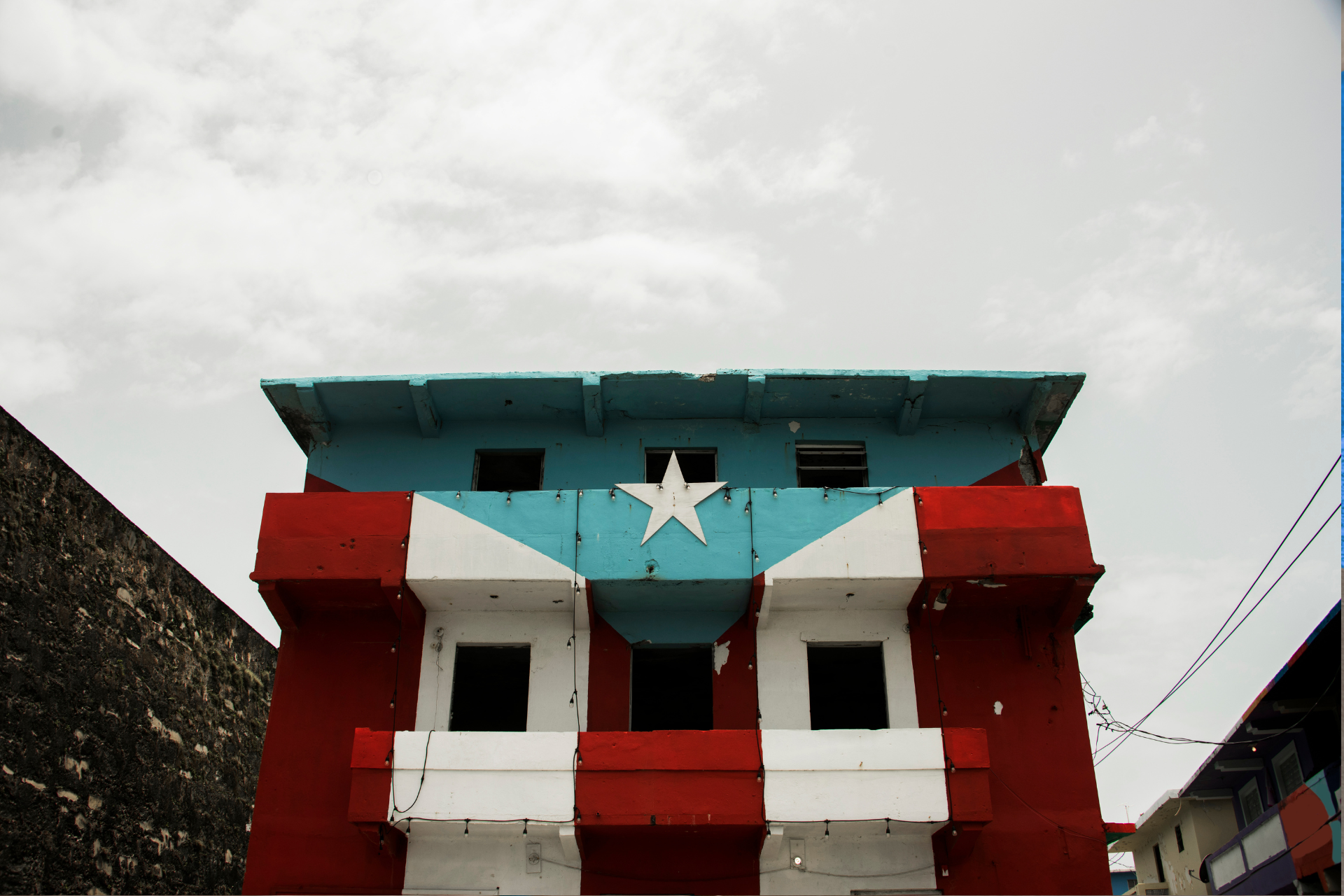
Puerto Rico and Greenland have some things in common, though they also have many differences.
Notably, Greenland has sovereignty akin to that of a state of the U.S. along with representation in its nation’s parliament, while Puerto Rico does not have sovereignty and has no voting members in Congress.
Yet they also have much in common. Both are islands deeply affected by climate change. Both belong to sovereign nations: Puerto Rico belongs to the United States and Greenland belongs to Denmark. Both were initially inhabited by indigenous people. Both were later colonized by Europeans, Greenland beginning in the early Middle Ages and Puerto Rico in the Renaissance.
A closer look shows additional differences and similarities.
History
Greenland was first inhabited around 2500 BC by paleolithic people who may or may not have been the ancestors of the current majority population of Inuits. Puerto Rico was first inhabited about 450 BC. On first European contact, the Island was settled by the Taino, an Arawak-speaking group. Many modern Puerto Ricans still possess some Taino DNA.
In the Middle Ages, the Scandinavian peoples began to consolidate small chiefdoms into nations, beginning with Norway in the 800s. In the 900s, Erik the Red was banished from Iceland, which at the time belonged to Norway, and set out for Greenland with 25 boats. 14 of them arrived safely and established two settlements. Erik the Red did not claim Greenland for Iceland, but for Norway, the owner of Iceland at the time. Things were complicated in Europe in those days, with Norway, Denmark, and Sweden joining and separating and adjusting their borders with Germany and Britain, but Denmark ended up ruling over Greenland from a distance. When the Black Death hit Scandinavia, communication between Greenland and Denmark ended.
Norway and Denmark joined into a single unit, the Twin Kingdoms, from 1536–1814. In 1721, a Danish missionary set out for Greenland, expecting to baptize the Norse settlers who had been without Danish support for centuries. Instead, he found that the Norse settlements had been abandoned. Denmark determined to support their claim on Greenland with new colonists, and was able to keep Greenland when it split with Norway in 1814.
Meanwhile, Columbus claimed Puerto Rico for Spain. While many of the islands in the West Indies suffered from the same fluidity of government found in Scandinavia, changing hands among imperial nations over the centuries, Spain was able to hold onto Puerto Rico until the Spanish-American War in 1898. When the United States prevailed in that war, the peace treaty between the U.S. and Spain included Spain’s cession of Puerto Rico to the United States.
At that point, both Puerto Rico and Greenland were territories governed entirely by the United States and Denmark respectively.
Puerto Rico: Enhanced Local Rule but Still a U.S. Territory
In 1952, Puerto Rico was able to elect its own governor and had its constitution approved by the U.S. Congress. The Island got a new name, the “Commonwealth” of Puerto Rico, but the federal government was very clear about the fact that Puerto Rico remained a U.S. territory with control only over its local matters.
The U.S. Senate explained when it approved Puerto Rico’s constitution that any Puerto Rican law in conflict with the U.S. Constitution or laws “would be null and void.” In the words of then-President Harry Truman, only authority and responsibility for local self-government would be “vested in the people of Puerto Rico.”
Puerto Rico still does not have any voting members in Congress, and the acceptance of the constitution did not change the relationship between Puerto Rico and the federal government.
Although the maneuver was described at the time by an Assistance Secretary of State as a “convincing answer to attacks by those who have charged the United States Government with imperialism and colonial exploitation,” the Island continued to be an unincorporated territory of the United States, as it still is today.
This means that the U.S. has authority to dictate the terms of Puerto Rico’s local law if it seeks to do so, as has been the case under the 2016 Puerto Rico Oversight, Management, and Economic Stability Act.
Puerto Ricans were historically divided on political status options: to remain a territory and try to negotiate an “enhanced commonwealth,” to become a state, or to become independent. As long as it was widely believed that an “enhanced commonwealth” was possible, the people were fairly evenly divided between statehood and “commonwealth.” When it became clear that core elements of an “enhanced commonwealth” were unconstitutional and not feasible, statehood became the preferred option. Independence is supported by a small number of voters.
Greenland: A Voice and Local Autonomy Protected in Danish Law
Greenland had a more gradual process of self-government, which Greenlanders expect to see ultimately culminate in independence for Greenland. Greenland was integrated into the Kingdom of Denmark in 1953, just about the same time that Puerto Rico gained its “commonwealth” title. Yet, unlike Puerto Rico, Greenland was given two seats in the Danish Parliament under the Danish constitution.
The Home Rule Act for Greenland was passed by the Danish Parliament in 1978, and ratified in Greenland in 1979. This law formally gave Greenland its own internal authority, power that it retains today, while also being subject to Denmark’s obligations arising out of international treaties and rules.
The relationship between Denmark and Greenland is currently covered by the 2009 Act on Greenland Self-Government, which begins, “Recognising that the people of Greenland is a people pursuant to international law with the right of self-determination, the Act is based on a wish to foster equality and mutual respect in the partnership between Denmark and Greenland. Accordingly, the Act is based on an agreement between Naalakkersuisut [Greenland Government] and the Danish Government as equal partners.” It includes a statement that Greenlandic is the official language of Greenland, and that Greenland can become independent if they choose to do so. This law supplants the Home Rule Act.
Like the Faroe Islands, Greenland is generally supportive of eventual independence but is not ready to give up Denmark’s financial support. Denmark currently pays for more than half of the expenses of Greenland. Greenland has internal divisions over the question of how to become self-supporting. Since Greenland is rich in minerals, some leaders would like to begin mining and use the revenue to become self-sufficient. Others, concerned about the environmental and cultural costs of such a plan, are not willing to take that route. They would prefer to rely on trade and tourism.
Independence, for Greenlanders, is not an uprising against Denmark but a goal Denmark and Greenland are working toward together.
Quality of life
Greenland is much, much larger than Puerto Rico, but Puerto Rico’s population is much, much larger than Greenland’s. This can make it hard to compare the two, but here are some data points:
- Greenlandic men have a life expectancy of 69.7 years, while women have 73.5 years. Puerto Rico’s numbers are 78 for men and 85 for women.
- Both Puerto Rico and Greenland are dealing with high levels of chronic diseases and mental health concerns, with Greenland facing one of the world’s highest suicide rates at 81 per 100,000 people, while Puerto Rico’s suicide rate is 5.5 per 100,000.
- Greenland’s political stability score is 87.08. Puerto Rico’s is 73.38, because of its lack of a permanent political status.
- The World Bank estimates Greenland’s per capita GNP at $58,499, while Puerto Rico’s is $25,240.
Broadly speaking, Greenlanders are more prosperous, but Puerto Ricans are healthier.
The 51st state?
Puerto Rico has been voting for statehood since 2012, and elected officials of the Island have made formal requests and introduced bills for statehood for more than a century. Statehood for Puerto Rico is probably more of a “when” question that an “if” question. In contrast, Greenland has said firmly that it has no desire to be a Danish state. Denmark has rejected all offers to buy Greenland. Taking a territory by force used to be a common strategy for growing an empire, but it has been illegal under international law since at least 1945, when the U.N. charter specifically outlawed it. Many nations, as well as the League of Nations, had previously rejected the idea of rights by conquest, but all statements of international law since World War II have agreed on this point.
It therefore appears more likely that Puerto Rico will eventually be the 51st state than that Greenland will, although neither possibility appears imminent at this time.