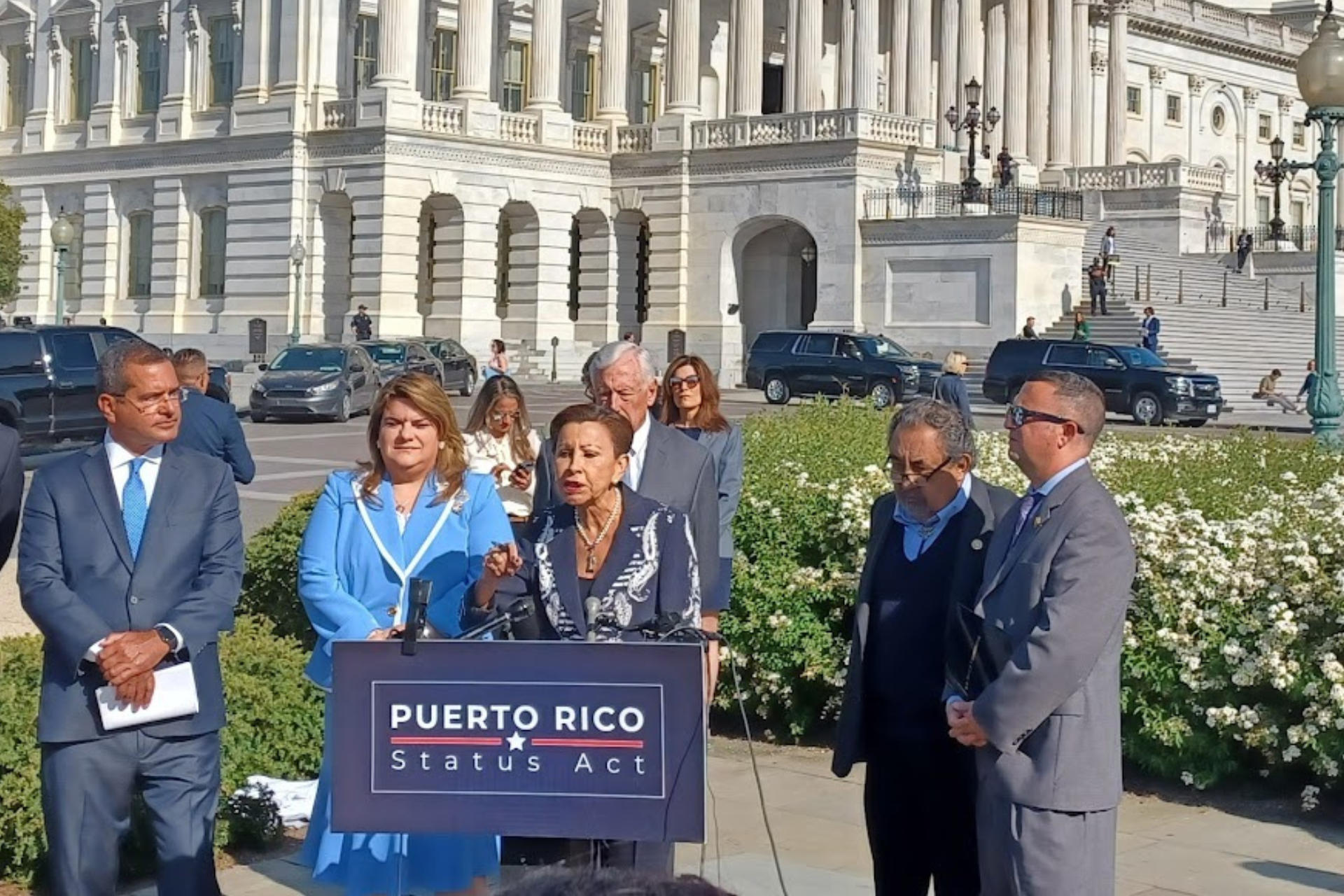
The U.S. Senate Public Lands, Forests, and Mining Subcommittee has announced a hearing to take place on Tuesday, June 18, to examine the following legislative proposals:
- S. 2944, “to enable the people of the Commonwealth of Puerto Rico to determine the political status of the Commonwealth of Puerto Rico, and for other purposes” introduced by Sen. Roger Wicker (R-MS)
- S. 3231, “to enable the people of Puerto Rico to choose a permanent, nonterritorial, fully self-governing political status for Puerto Rico and to provide for a transition to and the implementation of that permanent, nonterritorial, fully self-governing political status, and for other purposes” introduced by Sen. Martin Heinrich (D-NM) and with a growing list of 26 cosponsors
In a confusing twist, both bills are called The Puerto Rico Status Act. What is the difference between the two bills?
The original Puerto Rico Status Act
The original Puerto Rico Status Act was negotiated during 2021 to 2022 in the House of Representatives under the direction of then-House Majority Leader Steny Hoyer (D-MD). The compromise bill reflected input from members of both major U.S. political parties and both sides of the Puerto Rico status debate. The proposal allows a choice among constitutionally viable status options for Puerto Rico except for the continuing its current status as an unincorporated territory of the United States. The territorial option was rejected by voters in 2012.
The original Puerto Rico Status Act was passed by the House of Representatives in December of 2022 by a bipartisan vote of 233 – 191. At the time, President Biden endorsed the proposal, saying that it would would “take a historic step towards righting this wrong by establishing a process to ascertain the will of the voters of Puerto Rico.” The proposal died soon after it passed the House as Congress adjourned for the year.
When Congress reconvened in 2024, House Natural Resources Committee Chair Raul Grijalva reintroduced the Puerto Rico Status Act as HR. 2757. The Senate companion bill is Senator Heinrich’s bill, S. 3231. The two proposals are identical.
What’s S. 2944?
Sen Wicker introduced S. 2944 as an alternative to S3231. His expressed reason was that the voters of Puerto Rico should have the option of continuing in the Island’s current political status. Like S. 3231, the Wicker bill offers voters a choice among statehood or independence with and without the option of free association. It also offers a fourth option on the ballot: “commonwealth.”
Yet the sections of the bill that describes what a “commonwealth” is do not refer to the Island’s current political status as a U.S. territory. The text of the bill tells a different story, one of transitioning to a new arrangement. Explicitly, the Wicker bill describes a new U.S.-Puerto Rico relationship grounded in a “formal compact of political autonomy,” under which “any modification to the relationship shall be approved by the people of Puerto Rico by referendum.” This is not a description of Puerto Rico’s current territorial status.
The Wicker bill further explains a new process that will be set in motion if “commonwealth” wins the vote. It says that there will be “a ‘Bilateral Negotiating Commission’, which shall conduct studies and negotiations on changes to the Commonwealth-Estado Libre Asociado status within the general framework of commonwealth status, including the potential for a compact agreement between the United States and the Commonwealth of Puerto Rico[.]”
The process of negotiating changes to the status of the territory is described at some length. A few of its more striking characteristics include the fact that all Puerto Rican representatives on the Bilateral Negotiating Commission will be appointed by the “commonwealth” party and that the process is scheduled to take years, followed by ratification by Puerto Rico voters and Congress. In other words, Puerto Rico will continue in its current political limbo for some time.
Much of the language in the Wicker bill is taken word for word from a proposal by Jose Luis Dalmau, former president of the Popular Democratic Party (PDP) of Puerto Rico party in Puerto Rico.
Statehood or independence?
Statehood and independence, the two permanent political status options possible under the U.S. Constitution, are also described in the Wicker bill. The independence options (with and without free association option) are similar to the descriptions in the Heinrich bill, but statehood is quite different.
The description of statehood the Wicker bill is, “The State of Puerto Rico shall request admission into the Union of the United States on an equal footing with the other States in all respects and as a part of the permanent Union of the United States, subject to the Constitution of the United States, with powers not prohibited by the Constitution of the United States to the States reserved to the State of Puerto Rico.” (emphasis added)
The competing Heinrich bill describes statehood as “The State of Puerto Rico is admitted into the Union on an equal footing with the other States in all respects whatever and is a part of the permanent union of the United States of America, subject to the United States Constitution, with powers not prohibited by the Constitution to the States and reserved to the State of Puerto Rico or to its residents.”
The difference is significant. In S. 3231, Congress commits to following through and honoring the wishes of the people of Puerto Rico. Under S. 2944, a statehood vote would simply be a request for admission, with no further commitment from Congress to work to advance the process.
Puerto Rico has already formally requested admission as a state. The difference under S. 2944 is that the request would trigger a two-year study of the fitness of the territory of Puerto Rico to become a state. There is a list of items that must be studied, including “the impact of…the fact that, of the 98.7 percent of the population of the Commonwealth of Puerto Rico that is Hispanic, a substantial proportion considers Puerto Rico to be a Spanish-speaking, Latino nation.” Other items include whether the majority voting for statehood will still be a majority in the future and whether Puerto Rico has the resources to pay their debts.
“As soon as practicable” after the study is concluded and a report filed, Congress will vote on whether or not to admit Puerto Rico as a state.
In light of these hurdles, opponents have suggested that the actual goal of the Wicker bill is simply to delay the resolution of Puerto Rico’s status.
Updated on June 30, 2024