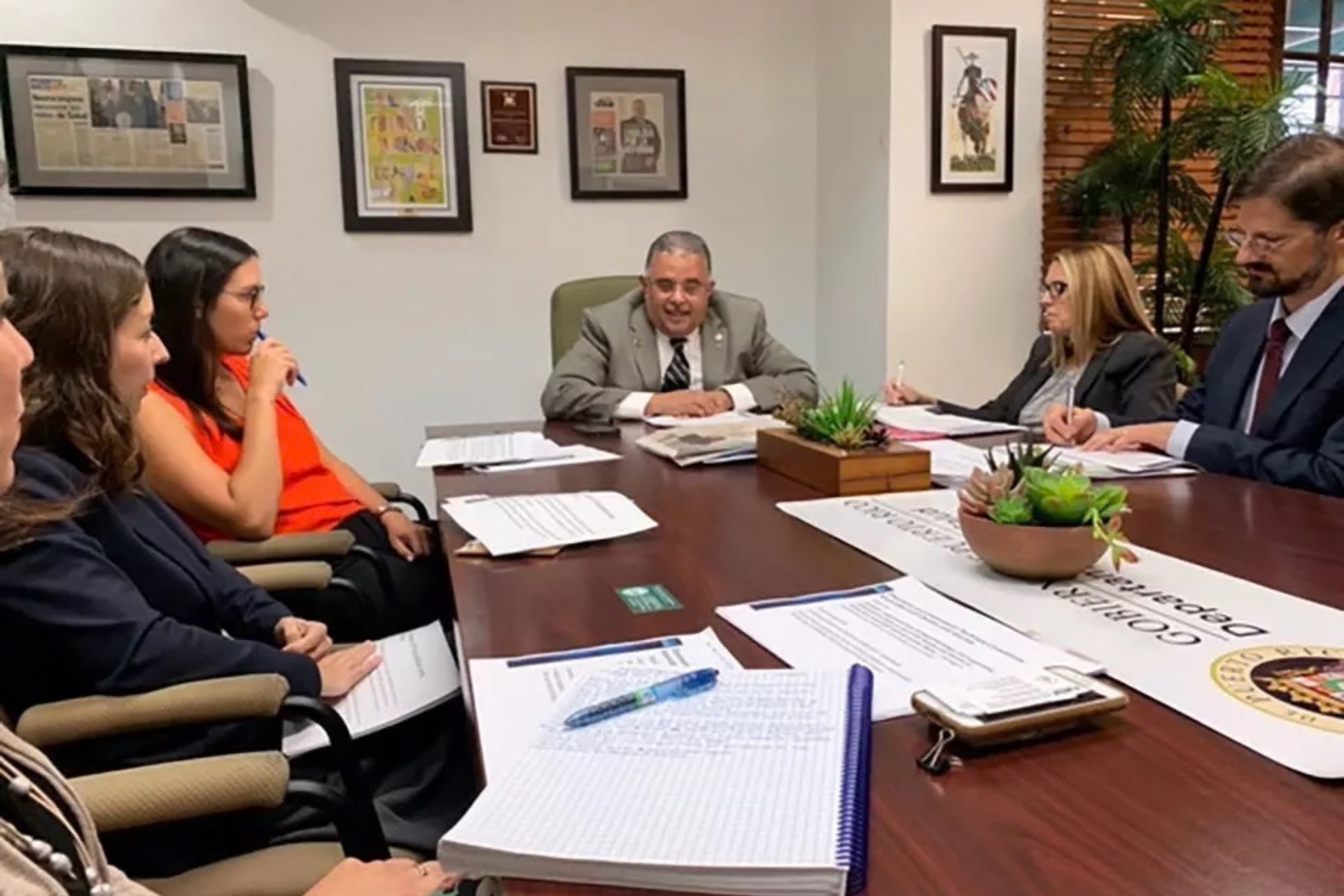
Luis Dávila Pernas, executive director of the Puerto Rico Federal Affairs Administration (PRFAA), announced last week that a Senate hearing on The Puerto Rico Status Act is being planned for June 18, 2024 in the Public Lands, Forestry and Mining subcommittee of the Senate Committee on Energy and Natural Resources.
First Senate hearing since 2013
If held, the session will be the Committee’s first hearing on Puerto Rico’s political status since 2013. The 2013 hearing, conducted by then-Chairman Ron Wyden (D-OR) and Ranking Republican Member Lisa Murkowski (R-AK) featured testimony from Ruben Berrıos Martınez, President of the Puerto Rican Independence Party; Alejandro Garcıa-Padilla, then Governor of Puerto Rico; and Pedro Pierluisi, then Resident Commissioner to Congress and President of the New Progressive Party.
Some highlights of that hearing included the following statements:
- “Puerto Ricans have achieved leadership in the U.S. military, in business, in the Congress, on the Supreme Court and in many other prestigious positions. But for Puerto Rico to meet its economic and social challenges and to achieve its full potential, this debate over status needs to be settled. Puerto Rico must either exercise full self-government as a sovereign nation or achieve equality among the states of the Union.” — Ron Wyden
- “If another referendum is called in the Commonwealth, the people of Puerto Rico should be presented with clear and unambiguous options for such a significant decision, so as to match our shared democratic principles.” — Joe Manchin
- “I represent more U.S. citizens than 42 Senators. My constituents have fought side by side with your constituents from Korea to Afghanistan. They can move to the states for the price of a plane ticket. But if they stay in Puerto Rico they cannot vote for President, have no representation in the Senate and elect one member to the House. I can only watch as my colleagues cast Floor votes on bills affect- ing every aspect of life on the island. I depend on the good will of Senators elected to protect the interest of their constituents, not mine. I request assistance from a President who is not required to earn a vote in Puerto Rico.” –Pedro Pierluisi
- “With my support the Administration requested an appropriation to conduct the federally authorized status vote in the territory’s history. With a declared goal of resolving the issue that funding was approved by the House Appropriations Committee confirming that the effort to secure justice for Puerto Rico is not and should not be a partisan issue. For Puerto Rico to resolve its ultimate status it must become a State or a sovereign Nation either independent from or in association with the U.S. Territory status should not be an option because it has failed. An enhanced Commonwealth cannot be an option because it is fiction.” –Pedro Pierluisi
- “Inevitably, in any case, Congress will soon have to face its responsibility and make real self determination possible. Such self determination demands an informed choice between our inalienable right to independence as a distinct and separate nationality and the terms and conditions of any other non territorial alternative which the U.S. is willing to consider.” — Rubén Berríos Martinez
- “One of the choices on the November ballot was sovereign free association. In English, this phrase would be taken to mean the current free association relationship between the U.S. and the 3 nations of the former U.S. administered trust territory of the Pacific. However, some are concerned that when this phrase is expressed in Spanish voters may confuse it with the Spanish phrase for the current Commonwealth or the proposed enhanced Commonwealth.” — Ron Wyden
- “Mr. Chairman, nobody knows what enhanced Commonwealth means. They’ve been trying to define it for half a century. Nobody knows. So the answer is nobody knows. This is just political hocus pocus, political bull, to put it in plain English. So you shouldn’t stress the point anymore because they won’t define it. In definition it is their name for the territory.” — Rubén Berríos Martinez
- “Statehood lose in 1993, in 1998 in 1967. We are not proposing to exclude statehood because they lose. Exclude the Commonwealth from the ballot is disenfranchisement. That’s why I am in favor of including all the formulas, all the ballot formulas, all the ballot options in the ballots. I think that’s fairness.” — Alejandro Garcıa-Padilla
Read the transcript of the 2013 hearing.
The importance of the hearing
While the Senate has not held a hearing on Puerto Rico’s status in more than a decade, the House has held a number of these hearings in recent years. The House passed The Puerto Rico Status Act in 2022, but there were complaints from some Members that there had not been enough public hearings on The Puerto Rico Status Act in particular. A Senate hearing could provide a long-sought opportunity for the public discussions these congressmen desired.